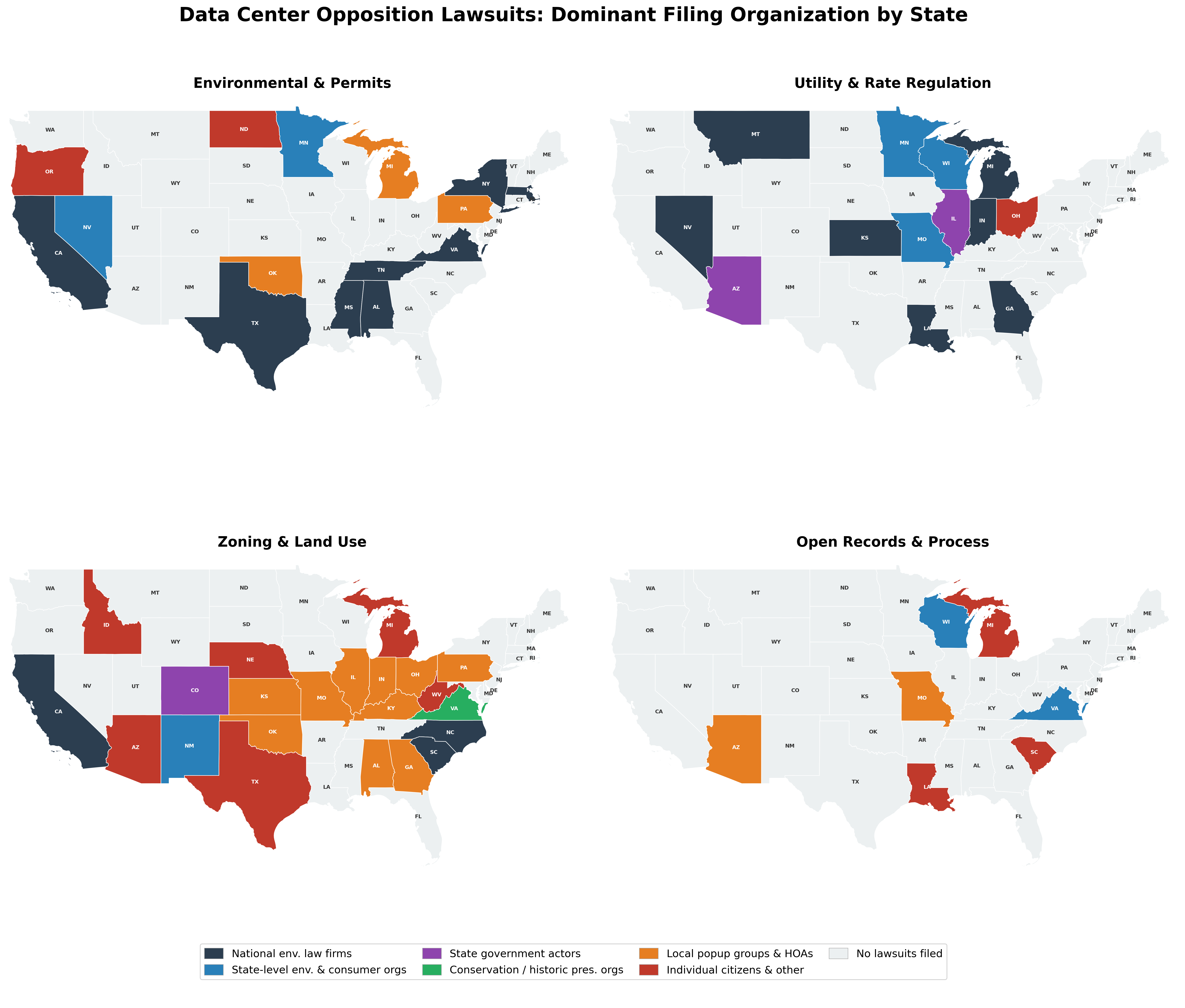
Unlike zoning and transparency lawsuits, which are mostly filed by local opposition groups and private residents, two other lawsuit types are the domain of established state- and national-level NGOs: utility and rate regulation lawsuits, and environmental and permitting lawsuits. Why? These cases require considerable expertise in regulatory procedures, utility economics, and environmental law — expertise that grassroots groups that form in response to specific data center proposals simply don't have.
Utility and rate regulation lawsuits.
No grassroots organizations — defined as groups which have recently formed for the express purpose of opposing data centers — have filed any lawsuits concerning utilities and rate regulations. These lawsuits are almost exclusively filed by established NGOs with national and state-level legal capacity, such as environmental and consumer organizations, because they require considerable expertise in regulatory procedures and utility economics.
In some cases, regional and national NGOs collaborate with local groups: regional NGOs provide local expertise, local groups provide legitimacy and co-sign while national NGOs lead legal strategy. State actors like attorneys general also play a unique role in utility lawsuits via statutory authority.
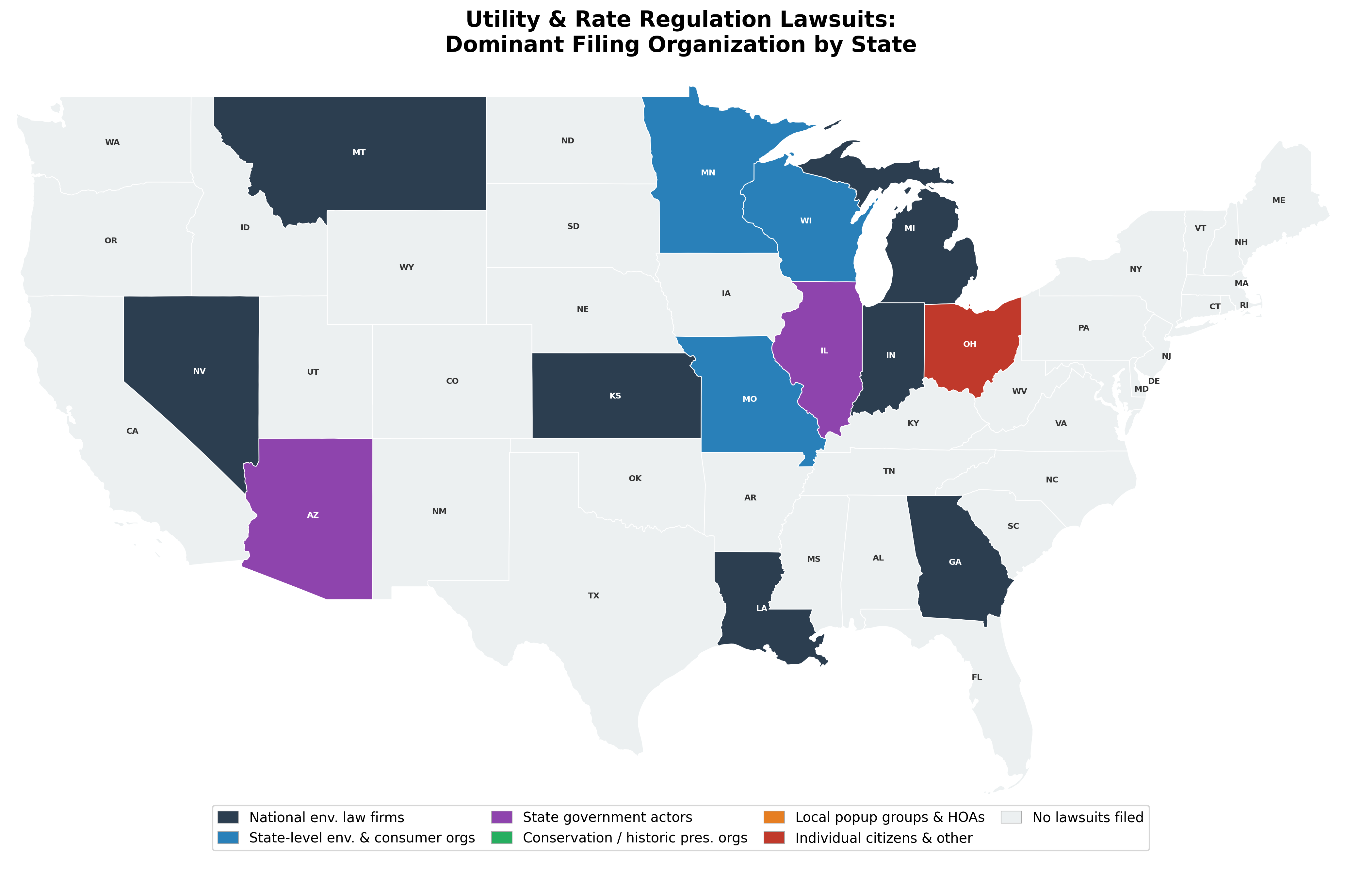
The Earthjustice model: Utility lawsuits tend to be less successful than other lawsuit types at stopping projects outright. But they have brought something hugely valuable: settlements with ratepayer protections, as in Indiana, Kansas, and Missouri. These settlements need not be clear wins to satisfy plaintiffs — they serve as models that travel to other states. Earthjustice operates in nine states, initiating large utility cases with potential for national ratepayer significance where local client organizations can serve as collaborators.
Environmental and permitting lawsuits.
Environmental lawsuits vary widely in complexity. Where a case sits on this spectrum tends to depend on the level of the nonprofit filing it — and both the technical complexity of the claim and who files it often determines success.
- Local grassroots organizations, private residents, and HOAs tend to file simpler environmental claims relating to nuisance and property damage. Thus far, they have not won these lawsuits.
- National and established state environmental NGOs lead the more technically complex environmental and permitting cases — and they appear substantially more successful.
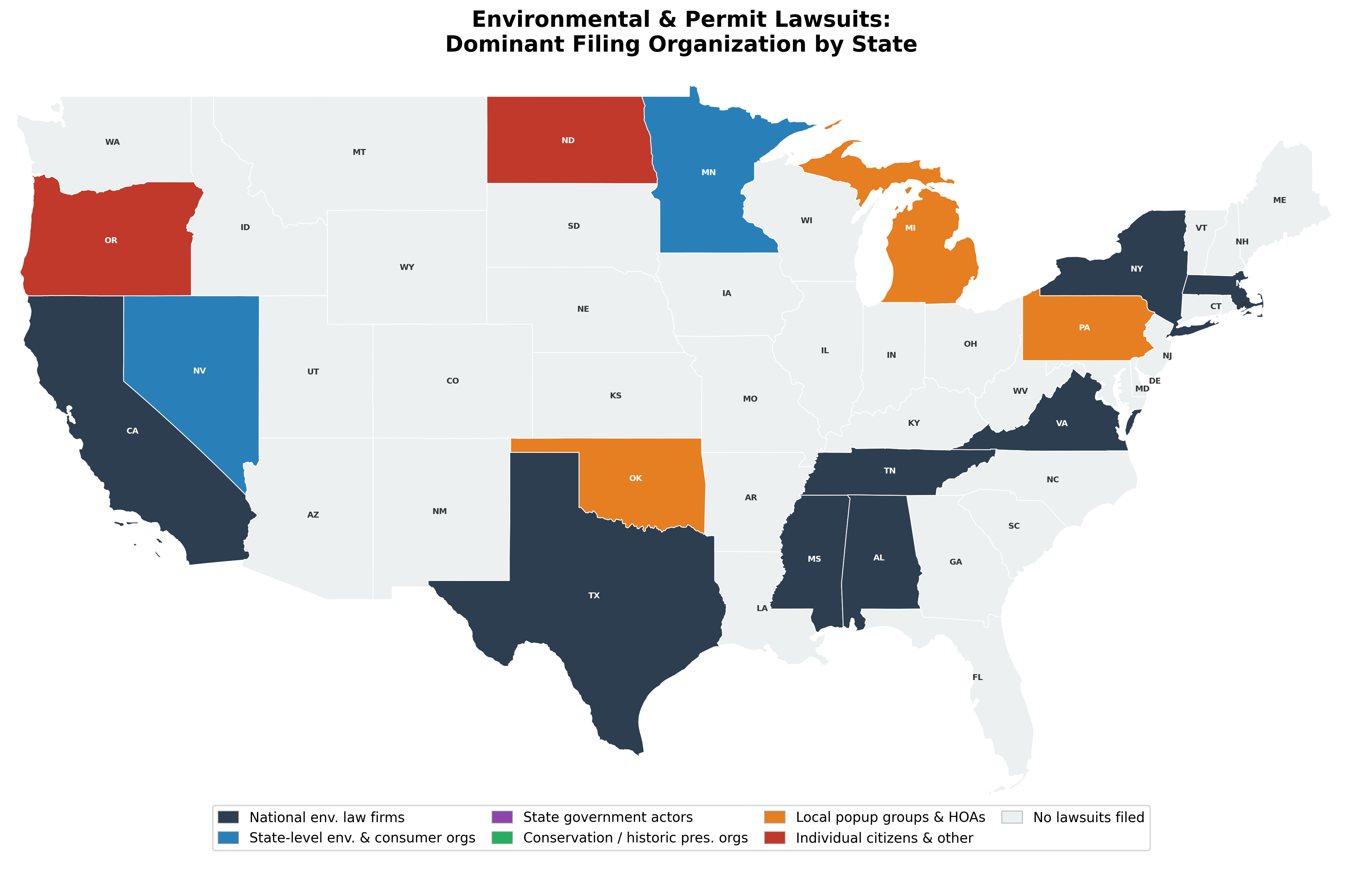
One reason for this gap is case selection. Unlike grassroots groups, which tend to file wherever a project lands in their backyard, large NGOs carefully choose cases they are most likely to win. The Southern Environmental Law Center (SELC), for example, is currently challenging the zoning ordinance for a data center developed by Eagle Rock Partners in Colleton County, South Carolina. This is a carefully chosen site: it borders the ACE Basin, which allows SELC to broaden their zoning dispute to encompass cultural heritage and conservation easement arguments that would be unavailable at a generic rural site.
Case study — xAI / Colossus 2: One of the most technically complex pending cases involves xAI and a coalition of Earthjustice, SELC, the Mississippi State Conference of the NAACP, and the national NAACP. These groups sent a notice of intent to sue over xAI's 27 methane gas turbines at Colossus 2 in Southaven, Mississippi. SELC and Earthjustice provide the legal expertise; the NAACP provides community standing and an environmental justice framing in a majority-Black community. The case is simultaneously a federal air permitting challenge (Clean Air Act New Source Review) and a public health argument — emblematic of the complex, multi-angle cases that national NGOs pursue.
National NGO penetration — where it's highest.
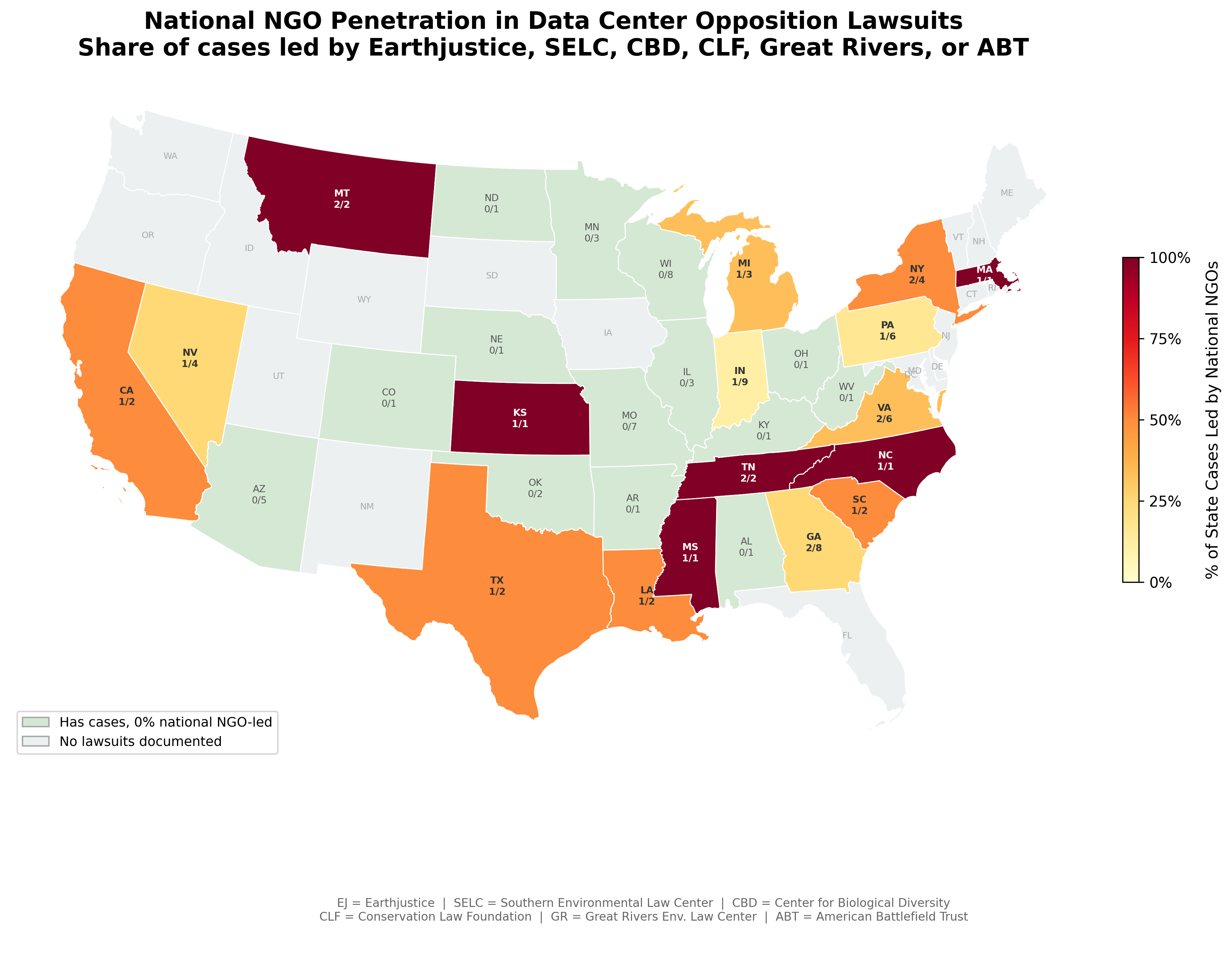
The map above reveals a clear geographic pattern. National NGO penetration is highest in the Southeast — particularly North Carolina, South Carolina, Tennessee, and Mississippi — where SELC has deep roots and is actively expanding its data center litigation strategy. Montana and Kansas show high penetration driven by Earthjustice's utility rate work. States with the lowest national NGO presence tend to be early-stage opposition environments where movement-building is still local.
What does this mean for you? National NGOs are reaching out to grassroots actors, and the mobilization scene is evolving quickly. Organizations are selecting cases strategically — which means a project that attracts national NGO attention faces a more sophisticated, better-funded opposition than media coverage alone would suggest. Tracking trends in organizational capacity and lawsuit types gives you an edge: an ability to identify vulnerabilities and predict threats before they materialize.