
America's rapid build-out of data centers — the critical backbone of the AI transition — is rapidly generating an enormous amount of public interest and political activity. The total built-area of American data centers is projected to increase by 540% by 2030. Many city governments view data centers as sources of income and move quickly to offer tax incentives to attract them. Local residents don't always agree, objecting to utility rate increases, environmental hazards, and noise.
As the presence of data centers grows, so do the contentious politics that surround them. Grassroots organizations are launching and winning lawsuits against county governments which fail to hold data center developers accountable to procedural requirements. County councils are innovating new ways to pass and enforce local noise ordinances and moratoriums on data center development, and exclude data centers from approved land-use zoning categories.
There are two major routes through which opposed citizens successfully obstruct data center development. First, residents and community-based organizations can file petitions and lawsuits targeting county councils over land-use zoning, permits, and public disclosures. Second, county councils can pursue new ordinances and moratoriums on data center development. Both routes are shaped by the existing regulatory environment.
Local Governance Matters.
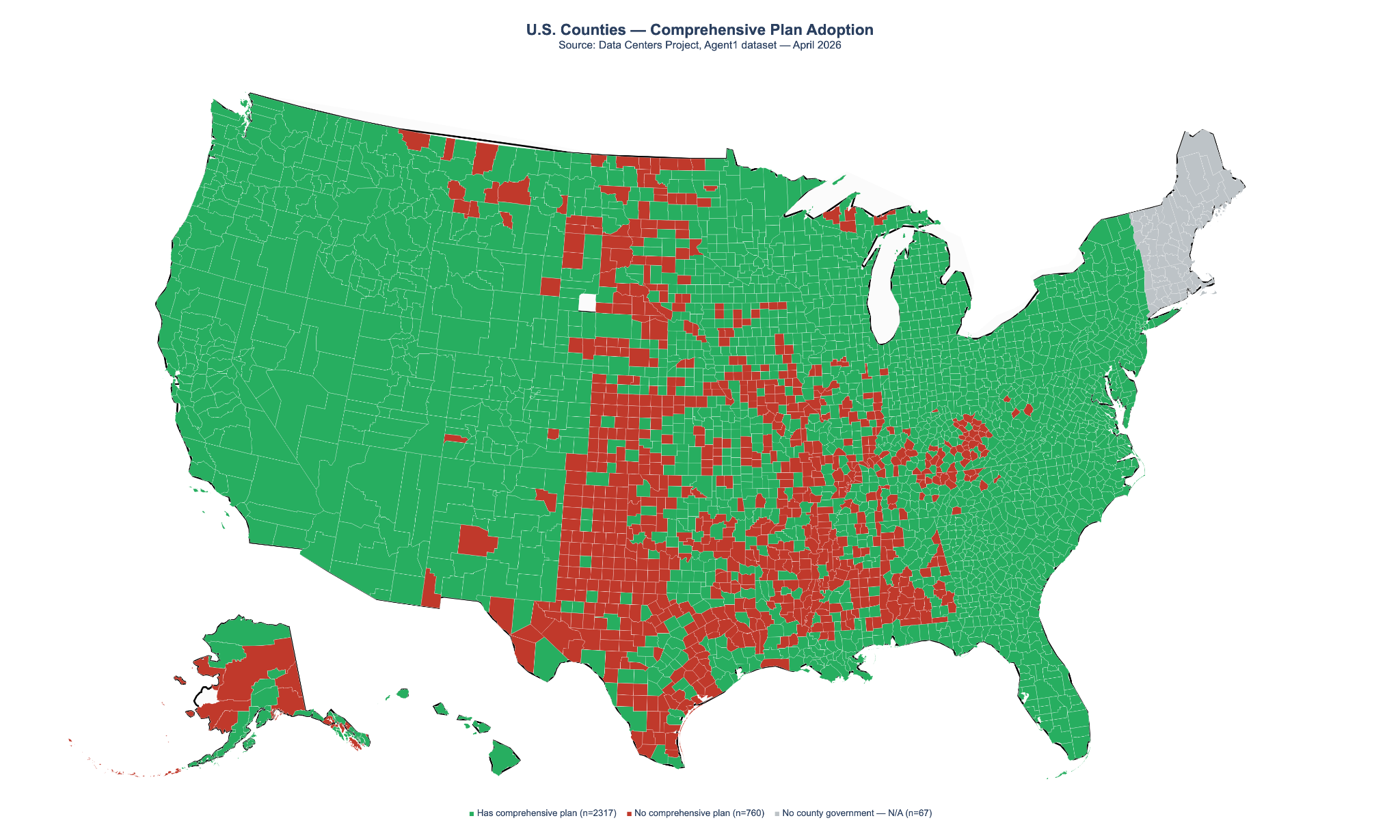
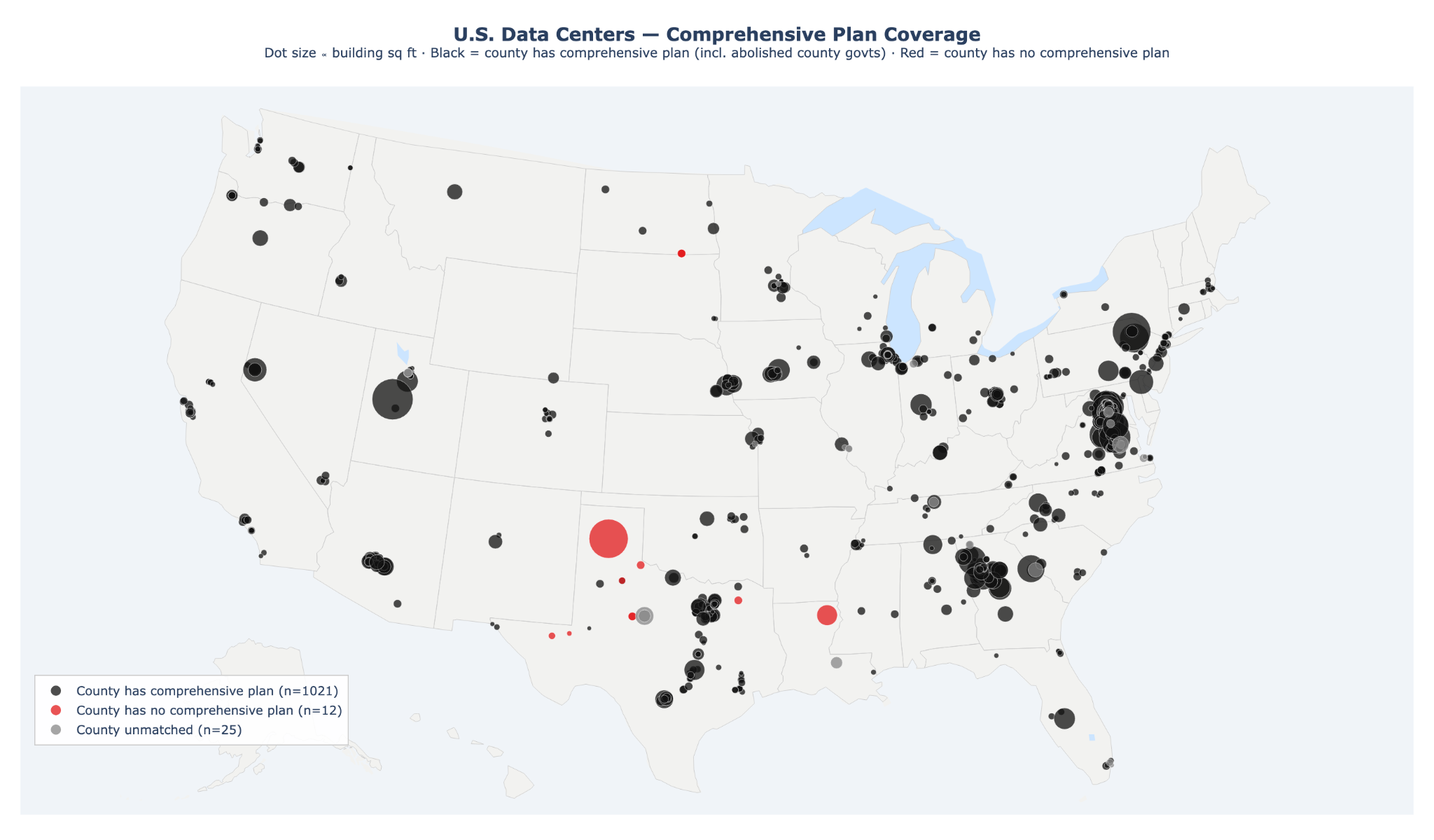
Most data centers are built in counties with strong county councils — those with authority over land-use and urban planning above and beyond state officials. These are counties with comprehensive, long-term infrastructure plans that can ensure reliable power supply and provide regulatory stability. It's obvious why nearly all counties (94%) with already-built or under-construction data centers are located in counties with comprehensive plans — long-range policy documents guiding future growth, land use, and development for ten to twenty years.
We know of only 12 data centers built in counties with no comprehensive plans. Several are crypto or AI compute operations sited in unplanned rural areas in Texas, North Dakota, and Louisiana. Moreover, as more data centers increasingly generate their own power on-site rather than rely on the public grid, the costs associated with builds in more stable but heavily regulated areas will likely push more development into unincorporated areas of counties, or counties with no comprehensive plans.
A Double-Edged Sword.
Counties with stable regulatory environments are also counties with numerous regulations. Most counties with comprehensive plans must solicit community input, hold public hearings, and seek approval from planning commissions to make any land-use changes. Each additional step in the regulatory process creates an opportunity for communities to question — and object to — the development of data centers.
Planning in unincorporated parts of counties offers developers a workaround. Take Project Matador in Carson County, Texas: a proposed 11–17 GW AI factory developed by Fermi America, with political backing from former Governor Rick Perry and land owned by the Texas Tech University system. Though sited on unincorporated land, the data center has secured infrastructural stability through political relationships and local partnerships.
Siting on unincorporated land has helped Fermi America avoid citizen opposition. Two grassroots groups formed to contest the project — Panhandle Taxpayers 4 Transparency, representing nearby landowners and farmers, and three national advocacy organizations launched campaigns (Sierra Club, Public Citizen, Media Justice). Most of the time, when grassroots organizations form to oppose data centers, they aim for low-cost but high-success approaches: contesting procedural minutiae around land zoning or public disclosures at the county level.
In Carson County, however, opponents could not target the county council, which lacks planning authority. Instead, they were forced to aim their actions at the Texas Commission on Environmental Quality (TCEQ). Despite 279 citizen complaints and a formal contested case hearing request, TCEQ approved a 6 GW gas permit for Project Matador. Legal action against utility regulators is far more difficult than zoning challenges, requiring sophisticated representation and evidence.
Project Matador is an outlier. Most counties have more robust regulations, and those that don't often move to acquire them. Meta's 7.5 GW AI data center in Richland Parish, Louisiana was built in a county that lacked a comprehensive plan — but the county is now rushing to initiate one. In Hood County, Texas, residents pushed the county council to place an incorporation measure on the November 2025 ballot, hoping to acquire zoning authority over a MARA Holdings bitcoin mining facility on unincorporated land. In the unfolding war between citizens and data centers, both sides are aware of the power that county-level administration yields.
Arizona: Where Zoning Laws Favor Developers.
Sometimes, but very rarely, zoning laws create leverage for developers rather than against them. In December 2024, the City of Phoenix adopted a zoning ordinance restricting data center development in areas previously eligible under the city's land use code — intending to limit large-scale industrial data center campuses in residential-adjacent and light-commercial zones. What Phoenix may not have fully anticipated was the legal mechanism that would be turned against it.
Arizona's Proposition 207 — the Private Property Rights Protection Act, codified at A.R.S. § 34-221 and passed by voters in 2006 — gives landowners a powerful tool when government regulation reduces the value of their property. If a land use law causes a "reduction in the fair market value" of a parcel, the owner is entitled to compensation from the government, unless the regulation falls within statutory exceptions for nuisance prevention or public health. Critically, the law gives municipalities an escape valve: they can repeal or amend the offending regulation within a specified period to avoid liability.
At least eleven landowners filed Proposition 207 claims in Maricopa County Superior Court following Phoenix's December 2024 ordinance. The single largest claim came from West Buckeye Rd LP, alleging a diminution in value exceeding $54 million. Across all claimants, the aggregate claimed diminution reportedly exceeds $753 million. If Phoenix defends its ordinance and loses, it could face hundreds of millions in compensation.
Everywhere else, strong county governance creates liability for developers.
More often, county-level zoning codes empower citizens against data centers. Comprehensive and master plans require that public hearings and notifications run in local newspapers in advance of council votes. When county officials are lax in following these requirements, they hand legal leverage to data center opponents.
Case study — Prince William County, VA: The delayed opening of the Digital Gateway campus came down to a single failure: the county clerk did not run a newspaper ad publicizing proposed rezoning ordinances, as required by the county's comprehensive plan. This procedural lapse gave opponents the legal hook they needed to challenge the approval.
In Indiana, where there are twice as many lawsuits opposing data centers as in Virginia, many ongoing lawsuits hinge on similar disclosure requirements. In one Lake County lawsuit, plaintiffs accused the county council of approving land rezoning for an Amazon data campus without holding required public information meetings. In a Morgan County lawsuit, residents challenged rezoning for a Google campus on grounds that it conflicted with the county's comprehensive plan.
Even moratoria depend on county-level administrative authority. 76 counties and townships have enacted temporary bans on data center development. 33 more have considered but not passed them. We know of no county that lacks a comprehensive plan and has either passed or even discussed a moratorium.
What does this mean for data developers and host communities? Counties with administrative authority over zoning provide citizens with avenues to push back that are difficult to predict or preempt. As development moves toward Tier-3 regions with weaker county councils, legal and moratorium risk may decrease — but reliability risks increase, and as Richland Parish and Hood County show, counties are actively working to close the regulatory gap.